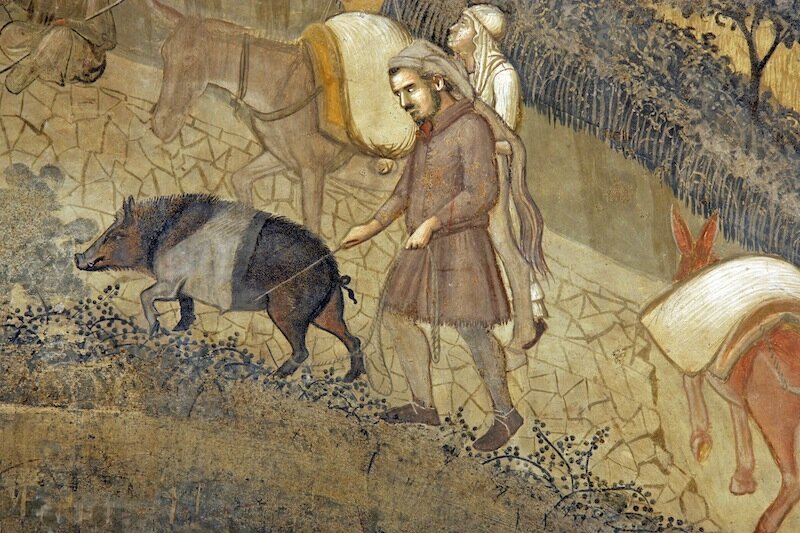
Particolare nell’affresco di Ambrogio Lorenzetti sugli Effetti in città e campagna del Buongoverno che mostra il governo dei suini
In the Statutes of Montalcinello (1561) it is impossible not to notice how, since ancient times, the oak played the role of true queen on the chessboard of community resources.
Alongside the well-known taxes on oil, wine, and meat, there was in fact a specific tax on the “soma” or “fastella” of oak wood, clear evidence of the economic and symbolic value attributed to this tree. The oak was not just timber: it was warmth for the winter, building material, a strategic reserve for the daily life of the village.
But the control did not stop at the wood. The statutes also provided for strict measures to protect acorns, a fundamental resource for pig farming. Anyone who shook oaks or holm oaks to make the acorns fall, as well as anyone who brought their animals to feed on someone else’s acorns, violating community rights and customs, was sanctioned.
Behind these rules there was not only the fear of theft, but a refined collective management of the forest, where every tree, every acorn, every gesture had a precise weight in the balance between individual and community.
In this sense, the oak was not just a tree: it was a pillar of the social and economic order of Montalcinello.