Leafing through the ancient statutes of Montalcinello (translated from Latin to the vernacular in 1561), one comes across a rule that today strikes for its harshness and theatricality: the “Punishment for those who blaspheme.” Not a simple fine, but a real public punishment, designed to educate by example.
What does the rule say, in today's words?
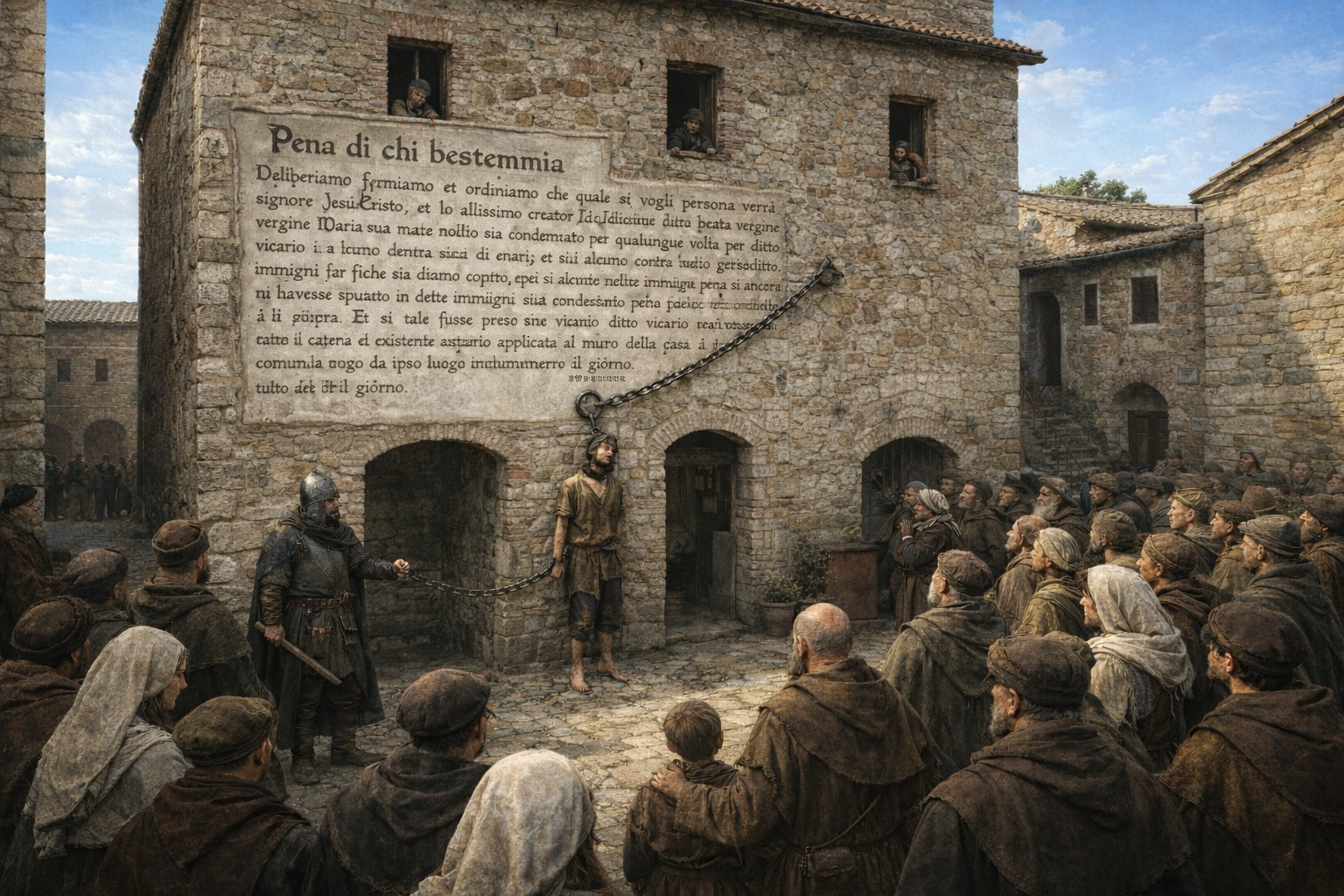
We establish and order that whoever blasphemes Our Lord Jesus Christ, Almighty God, or the Blessed Virgin Mary, shall be condemned each time to a fine of ten lire.
Whoever instead offends with obscene gestures (such as “making the fig sign”) against God, the Virgin, or their sacred images, suffers the same penalty.
And if someone even goes so far as to spit at the sacred images, the sentence is identical.
But if the culprit is caught in the act, the Vicar must have him tied with a chain fixed to the wall of the Town Hall, holding him by the neck, and leave him there exposed for the whole day.
More or less the same if one blasphemed a saint. In fact, in ancient times the punishment was not only economic or physical: it was above all public. The guilty party was immobilized in the heart of the village, to the wall of the Town Hall overlooking the square, under everyone's eyes. Shame, fear, and social control were fundamental tools of communal power.
In Tuscany, the irreverent land of Boccaccio and Dante, blasphemy is not just a swear word (I believe it is the same in my Veneto): it is a cultural fact layered over centuries. Despite centuries of repression, it has never disappeared. Not by chance, in a pastoral visit in 1911, the bishop of Volterra notes how blasphemy is the most widespread sin among the population of Montalcinello, more frequent than other morally condemned behaviors. Yet another visit in 1945 led the bishop to state that “the vice of blasphemy exists, in an excessive way” in Montalcinello.
A century ago, then, the Church recorded what everyday language had already transformed: blasphemy as a habit (not mine), as an outburst, as a filler, and as a linguistic gesture of rupture. It is the Tuscan paradox: a land where the sacred has been so present (for Montalcinello, the ecclesiastical control of Volterra), so controlled and regulated, that over time it generated a form of resistant, almost identity-defining, verbal desecration.
The stone remains.
The rules change.
Memory, if told, continues to speak.
We are Montalcinello.