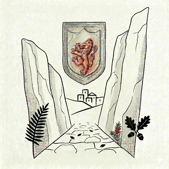
The Allegory and Effects of Good and Bad Government by Ambrogio Lorenzetti is that Sienese painting that showed the world for the first time how the management of a good becomes visible in space: orderly cities and cultivated countryside under Good Government, decay and insecurity under Bad Government. The landscape is not a backdrop, but the concrete result of political and moral choices. It is the same intuition that Eugenio Turri develops in the book The Landscape as Theatre: the territory is the stage of human action, a historical representation of the values of a community.
When I bought a small plot of land near the Pieve di Montalcinello, I thought I was taking a seat at the theatre: as off to the side as you like, but I wanted to be there, part of this great fresco. But let's get to its history.
Montalcinello and its church of San Magno were never alone. For centuries they were placed under the high authority of one of the most important pievi in the territory: the Pieve di San Giovanni di Sorciano, a true religious and civil hub, a place of assembly, prayer, and community decision-making. The very term pieve, from the Latin plēbs, tells of a people's church, born to welcome, unite, and spiritually govern an entire community.
This pieve, probably built in the 9th century, was the mother church of a vast ecclesiastical district, directly under the Bishop of Volterra, who exercised both spiritual and material authority over it. Its territory extended wide and fertile, including the areas now known as Cerciano, Pieve, and Poggiocorbo, in a landscape that still today preserves the echo of that greatness thanks to the tireless work of some "painter" and "actor" of Montalcinello.
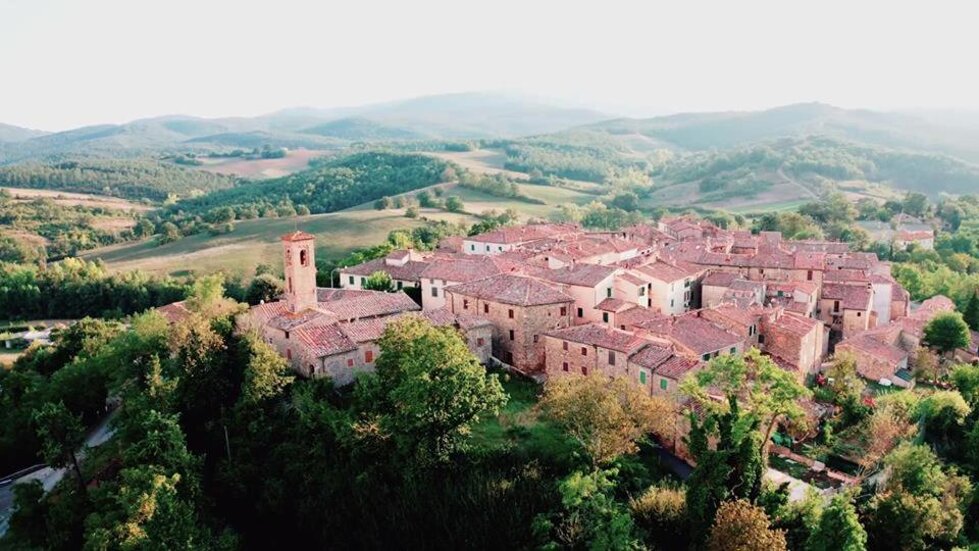
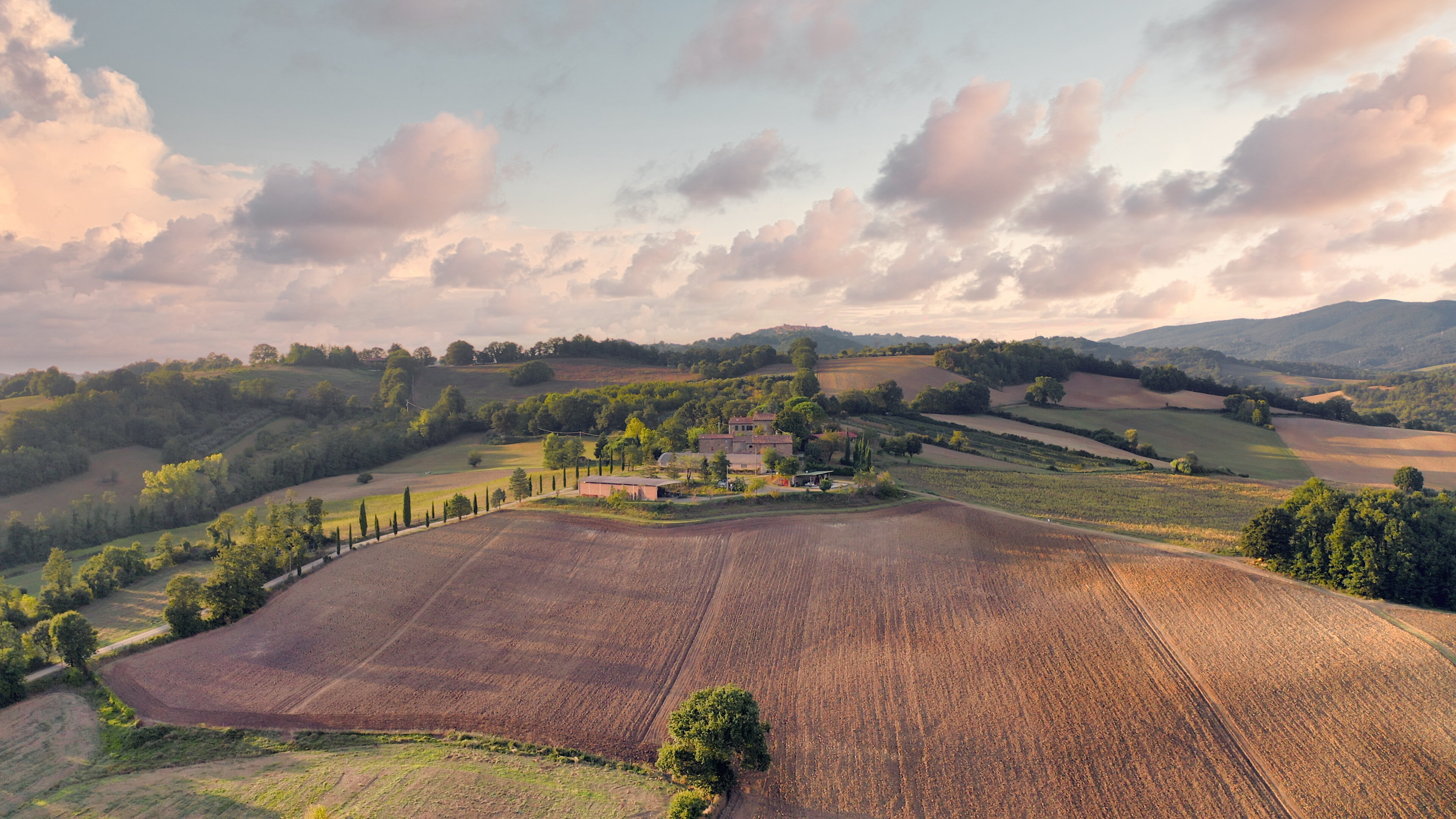
From the hilltop, the pieve dominated the panorama: Montalcinello in the foreground, Belforte in the background, rolling hills like a motionless sea, vast and silent skies. It was a place that united the sacred and nature, prayer and horizon.
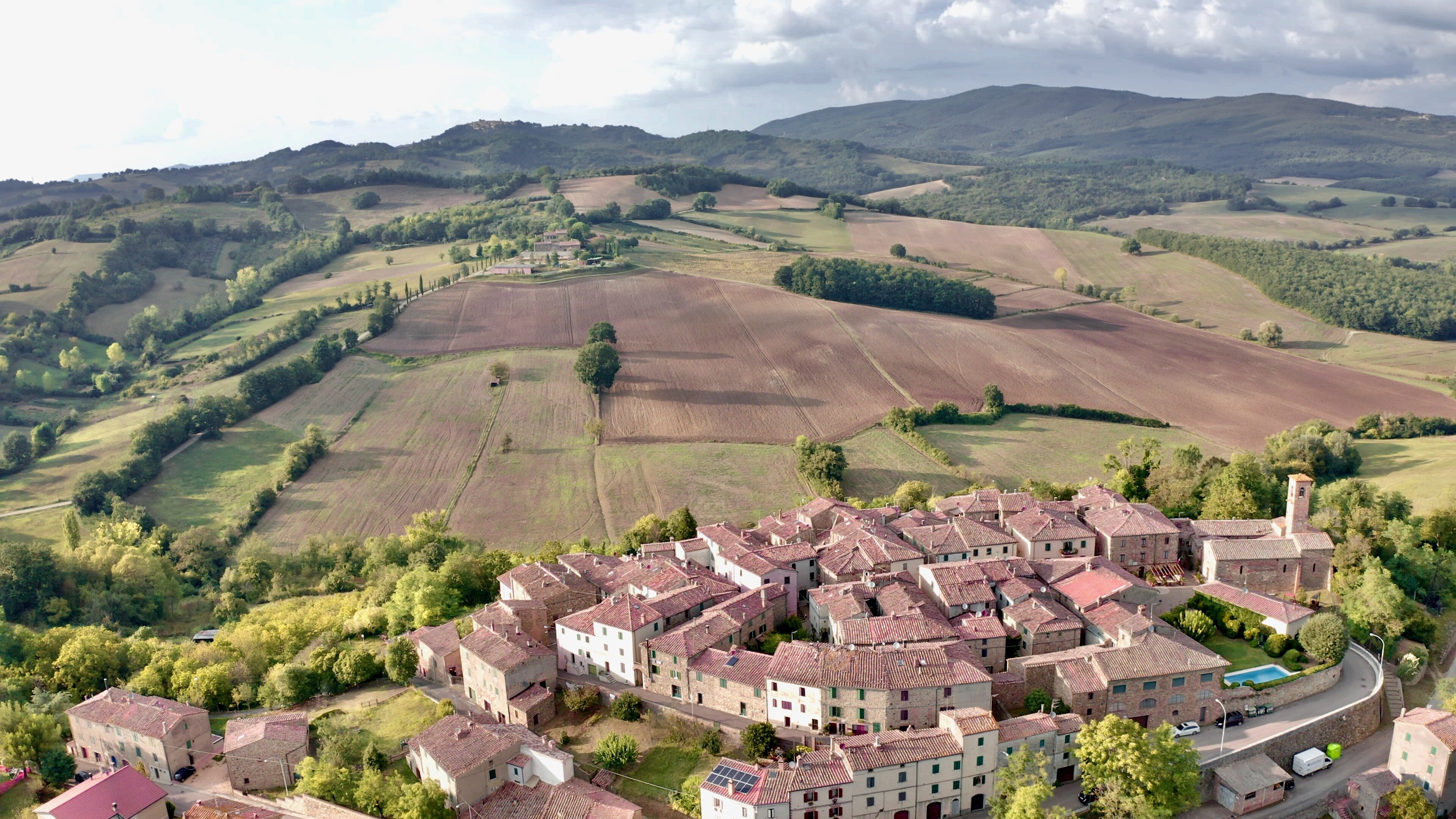
Aerial view of the Pieve between Montalcinello in the foreground and Belforte in the background
Its decline began in the second half of the 14th century, with the rise of the Municipality of Siena, when the title of parish church was transferred to the Church of Santa Maria di Belforte. From then on, the decay was slow but inexorable, worsened by the earthquake of 1436. There were numerous attempts at restoration, all in vain. Today, all that remains of the ancient church is a circular wall, probably the apse, the last architectural gesture reaching toward the sky. The surviving structures, intended for tourist accommodation (in order to book your place in the landscape write to info@agriturismogalgani.com), are in a privileged position, capable of offering a simply breathtaking landscape, where the gaze is lost and memories resurface.
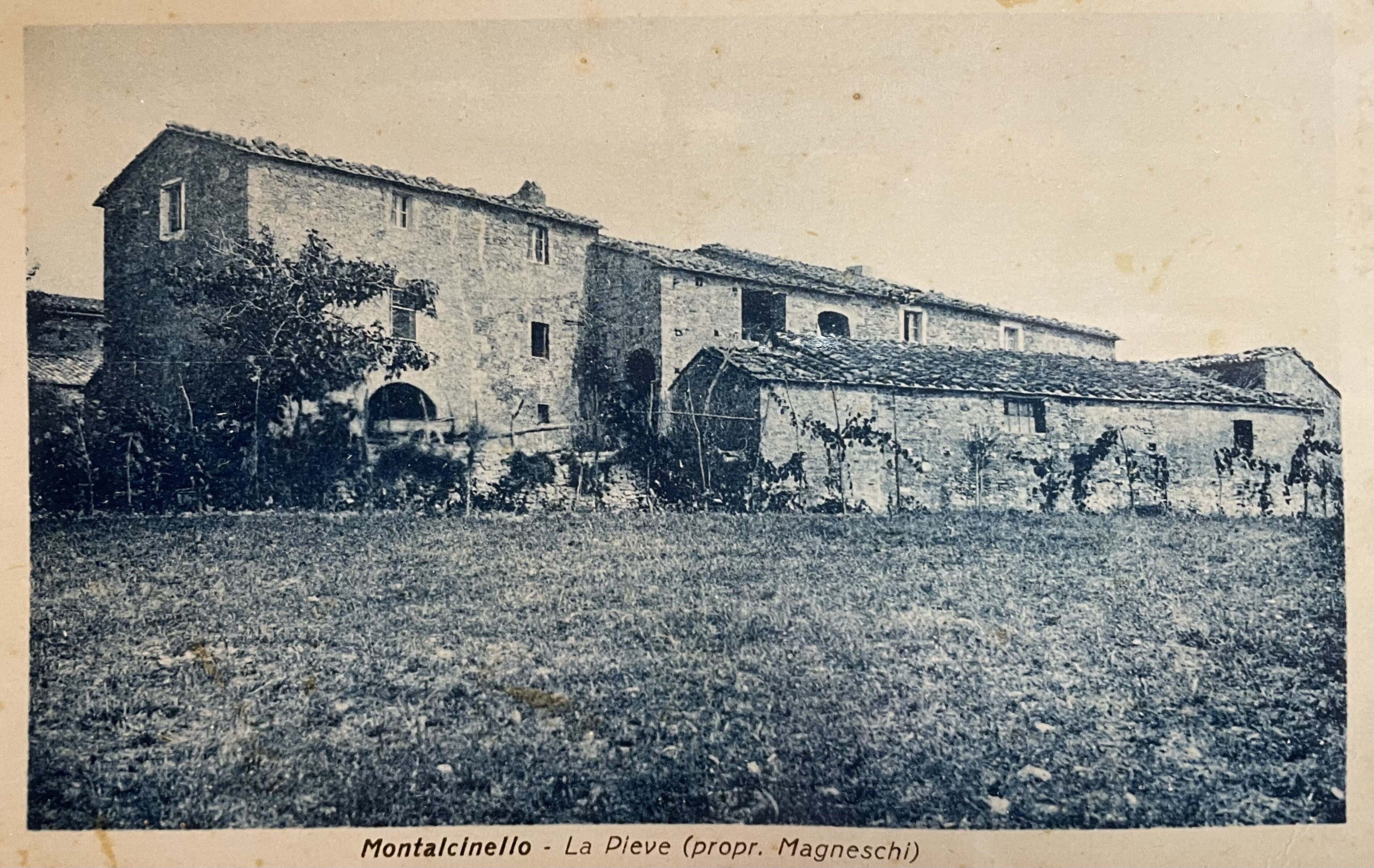
For centuries, the inhabitants of Montalcinello brought their deceased here, entrusting them to the sacred ground of the parish church. And until the early decades of the twentieth century, every June 24th, the day of Saint John, the entire village would move in procession towards Sorciano, in a collective rite of memory, faith, and belonging.
To seal this deep bond, an oral tradition also survives, according to which a secret tunnel connects Montalcinello to the parish church (we on the blog believe it), like an umbilical cord carved into the rock. Not by chance, the Statute of Montalcinello required that the road to the parish church always be clean and paved: four viarii, municipal officials, were tasked with ensuring its decorum. Furthermore, any crime committed within the parish church or in its subordinate Church of San Magno was punished with doubled penalties, as a testament to the absolute sacredness of these places.
Here, among stone, wind, and memory, we raise the parish church towards the heights of the heavens, temple of our village and its iconemes, proud symbol of who we are. We are Montalcinello.