
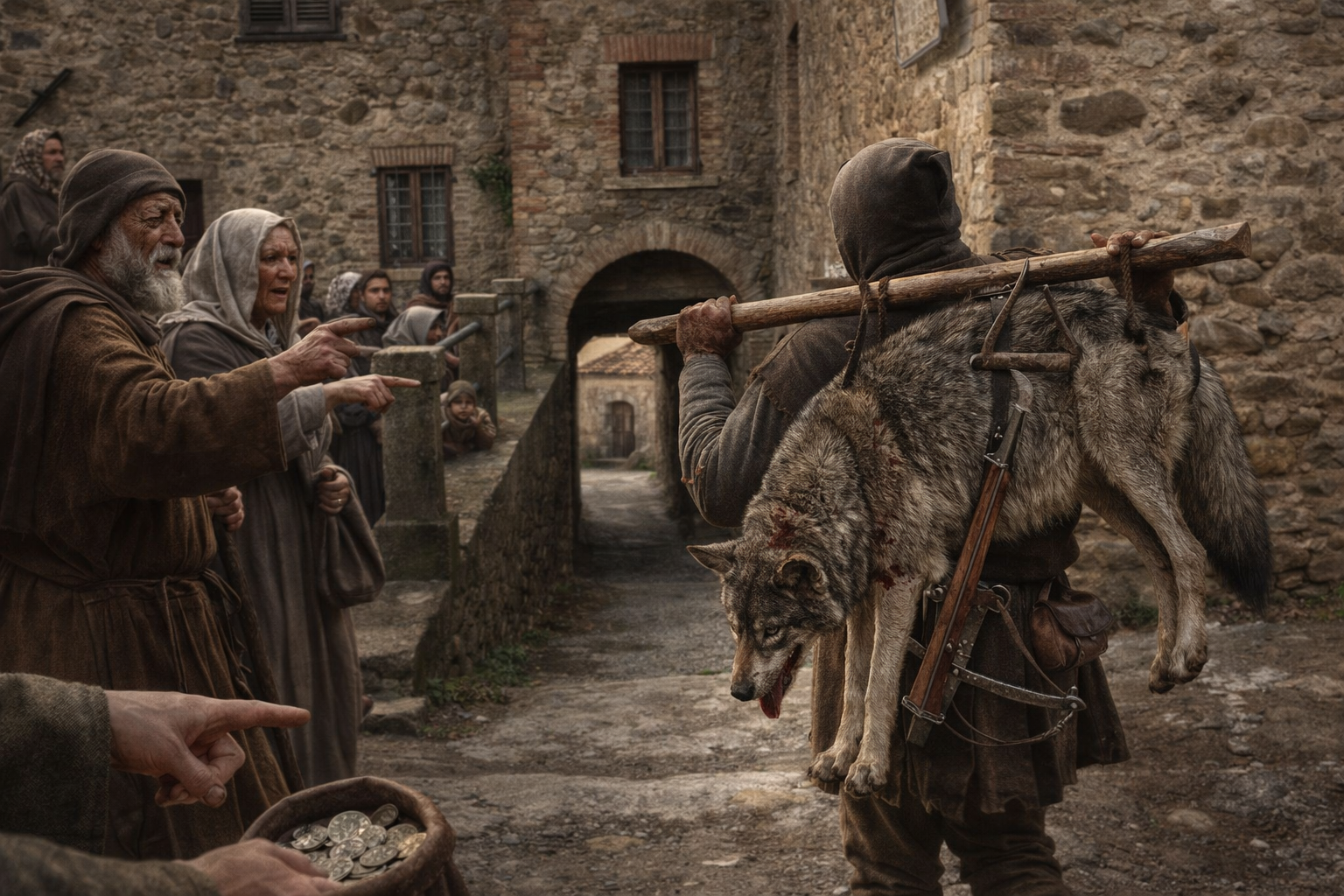
Consider that in the Statute of Montalcinello, which regulated the relations of our community certainly since the 14th century—and it would not be unreasonable to assume that these rules have roots in an even more remote era—a reward was provided for those who killed wolves, granted by the chamberlain: 20 denari for each wolf or she-wolf and 5 denari for a wolf cub.
A topic that remains divisive even today, but which already at that time hinted at the beginning of a deeper reflection when Saint Francis came to call the wolf “brother.”
In medieval Montalcinello, the presence of the wolf is also deduced from another significant rule of the Statute: the one that regulated the meat trade, in which explicit reference is made to “wolfed” meat, that is, meat from animals killed by wolves. A detail that suggests such episodes were far from sporadic and that the predator was an integral part of the ecosystem and daily life of the village.
Coming to the present day, we can state with certainty that the wolves have returned. Despite those who claim that it is a recent reintroduction, the Statute of Montalcinello unambiguously testifies that this predator has always inhabited our territory. Consequently, just as Canada could never deny the bear among its natural symbols, we too are called to find a way to coexist with this ancient inhabitant of the planet.
Today, science offers us an interesting perspective on the ecological function of wolves: studies on the Yellowstone Park ecosystem show that the presence of this top predator not only limits herbivore populations, but can also promote the rebirth and health of entire plant habitats, as happened with the park’s aspen trees after the reintroduction of wolves in the 1990s, helping to rebalance the surrounding ecosystem. This cascading effect demonstrates how the return of large carnivores can have much broader benefits than one might imagine, going far beyond simple predation.
It is true that the fear of the wolf has been handed down since the dawn of time, when among myths, legends, and real economic hardships the “werewolf” represented a concrete threat to the survival of villages, especially those in the foothills like ours. Today, however, it must be recognized that there are no recorded fatal incidents caused by wolves, while it would perhaps be more honest to admit that the speed at which humans drive constitutes a far more concrete danger, as do certain centralist policies that pay little attention to decentralized, rural, and agro-pastoral Italy.
The wolf, shy and elusive, instead plays a fundamental role in the food chain. Thousands of road accidents occur every year due to deer, fallow deer, and other ungulates, whose populations the wolf naturally helps to contain. Eliminating the top predator in the food chain thus appears to be an irrational act, which does not even take into account the economic and insurance consequences, especially in a context where the number of hunters is constantly decreasing and the wildlife balance can only be entrusted, at least in part, to nature itself.
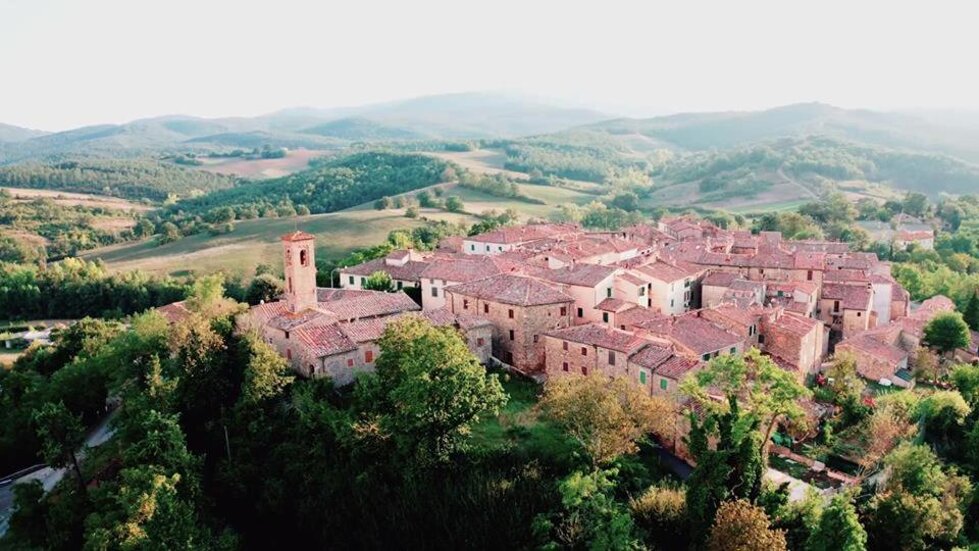
Returning to Montalcinello, the woods surrounding the village remain fascinating also for this reason: because, like Little Red Riding Hood, we know that the wolf exists. And perhaps it is precisely this awareness that makes our landscape even more authentic and alive.