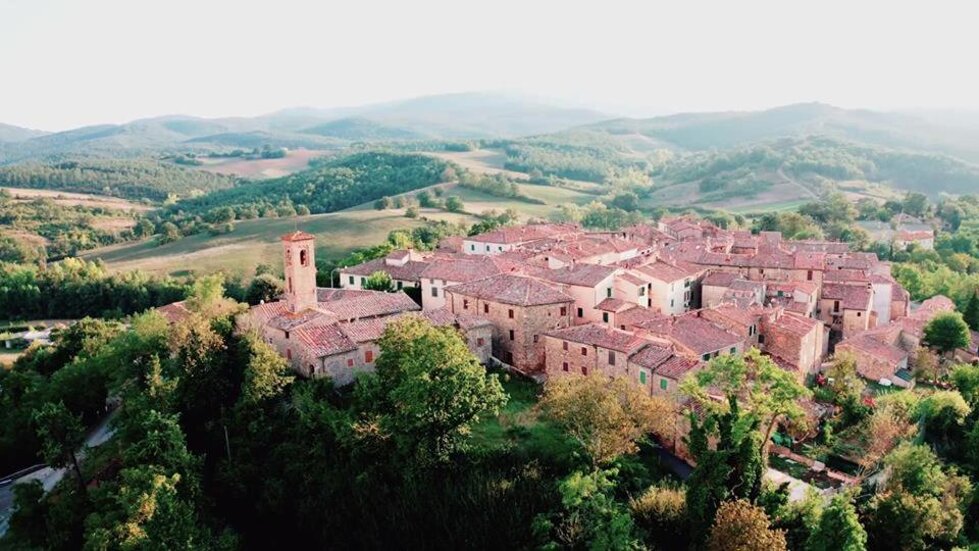
Among the many merits of the historian Evaldo Serpi is that of having brought to light the existence of a Statute of Montalcinello (1561), thanks to his tireless journeys between this remote village and the "civilization" of historical archives.
This set of rules regulated the relationships within the community – or Comunello – probably already in the 13th century, and certainly in the 14th and 15th centuries. To understand its prestige, just look at the map below, in which Montalcinello appears projected among the "giants" of the territory. It is not surprising that the stellar Roccatederighi and the comet of Montemassi appear there, which still today guides us as we drive towards the Maremma.
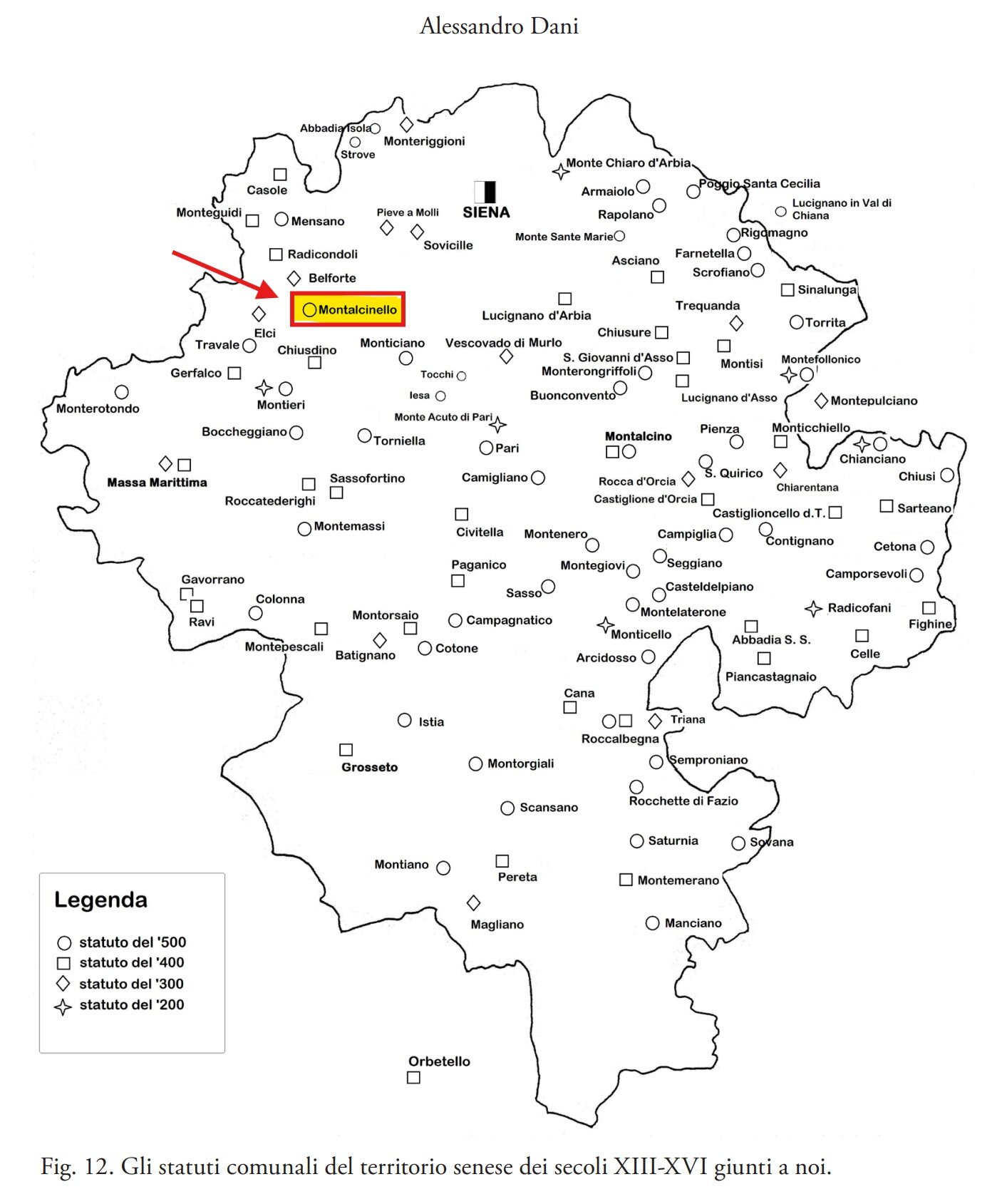
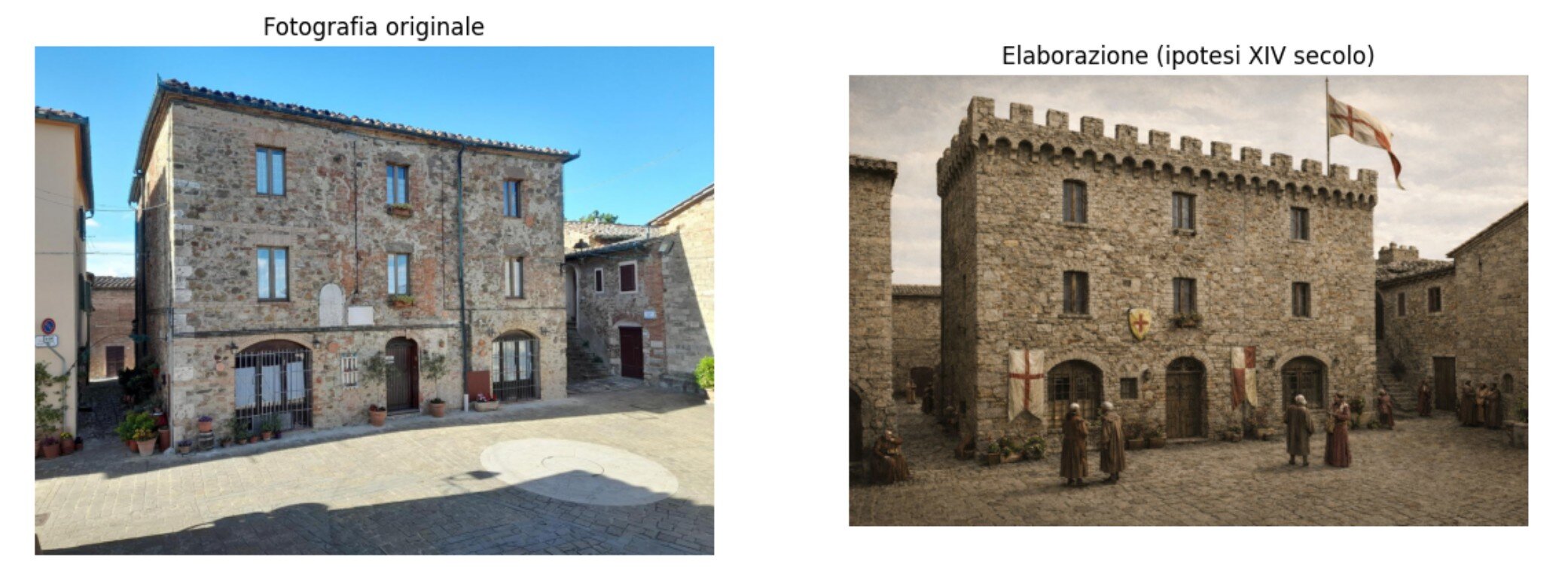
It is not only the surprising presence of a Mint, reminded to us by Lorenzo a few days ago on this blog, that suggests Montalcinello was much more than a marginal and forgotten village among the woods. What is striking above all is the mention, in the Statute, of a castle, a court, and a clearly defined district. And it is precisely from these clues that I would like to venture a hypothesis about the current Fattoria palace, where the restaurant will roar again from the end of April 2026.
What stands out, first of all, is a statutory passage that reads: «si facci alla porta di palazzo, o vero in la piazza», within the regulation that governed the deadlines assigned in civil cases. This formula seems to directly link the town hall to the square, which in the Statutes is explicitly defined as «the paved town square». Nothing surprising, actually, if we consider that normally the town hall (also defined in the Statute as Casa del Comune) was located overlooking the main square in many other places.
As for the identification of the castle, it is plausible to believe that in Montalcinello there was not an imposing fortification like those in the collective imagination of Montemassi or Frosini, so to speak. The term castle would rather seem to refer to a widespread defensive system, consisting of castle walls on which houses also leaned – not by chance, it was forbidden to open windows there – with a guard service active day and night and a moat, whose memory survives in the current via del Fosso.
At this point, another source comes into play: a report drawn up in 1676 by Bartolomeo Gherardini. In it, it is stated that the castle was small, composed of just thirty-five hearths, reinforcing the hypothesis that it refers to a "widespread" castle rather than one concentrated in a single structure. The report adds that the village was surrounded by walls and equipped with two towers. Among the public buildings, a palace is finally mentioned again, this time of justice: and it is legitimate to wonder if, once again, it is the same building.