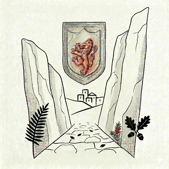
In the heart of the Terre di Siena, the concept of managing public affairs has deep historical and philosophical roots. As early as the 14th century, Ambrogio Lorenzetti, frescoing the walls of Siena’s Palazzo Pubblico with the Allegory and Effects of Good and Bad Government, showed graphically how architectural harmony, flawless road upkeep, careful building, and the economic vitality of communities were the direct reflection of wise, far-sighted leadership driven by love for the common good. Conversely, rubble and urban neglect were depicted as the inevitable symptom of submission to decay, propaganda, and private interest.
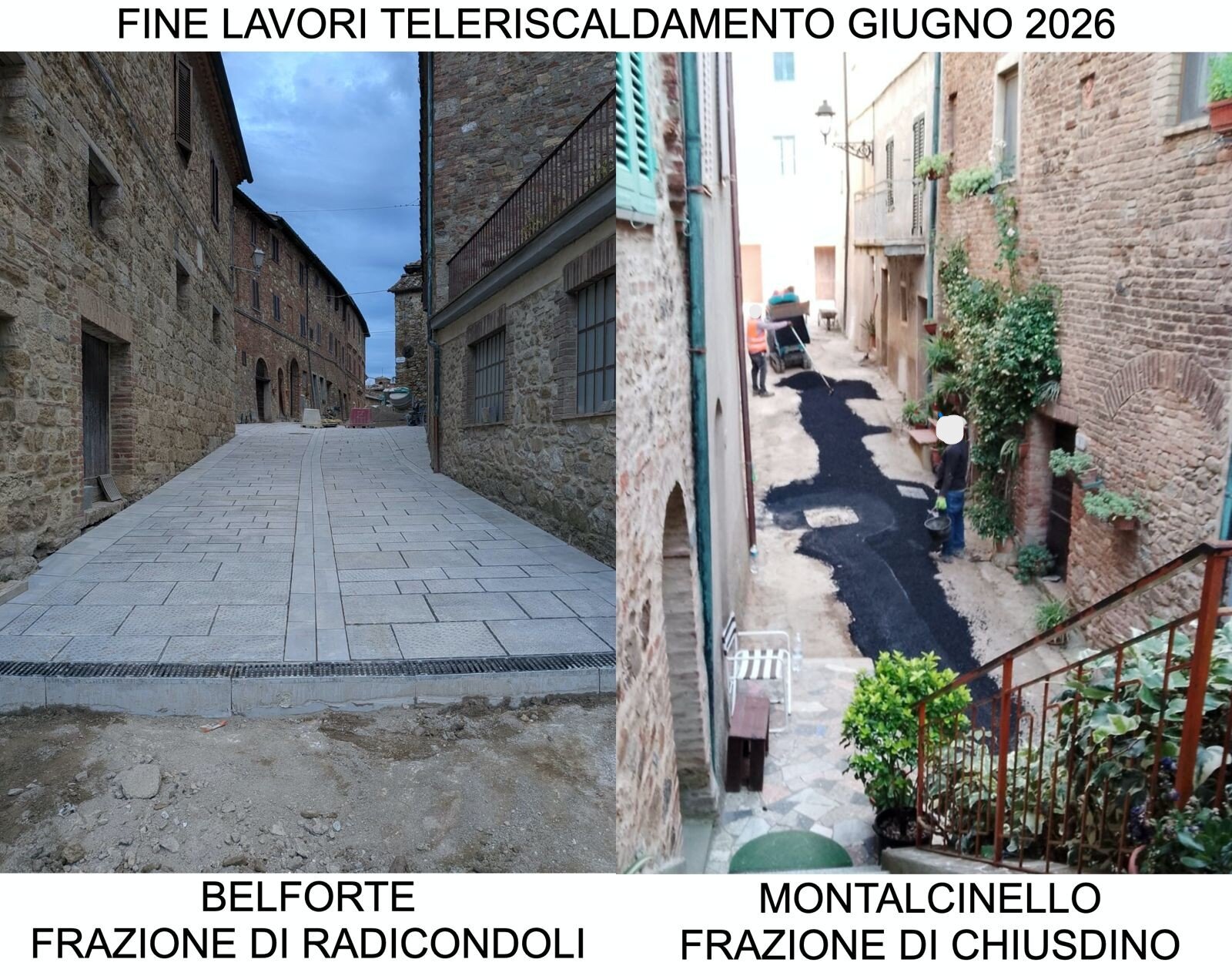
Centuries later, the visual comparison offered by the image above, relating to the completion of district-heating works in June 2026, dramatically re-proposes this dichotomy in the Sienese area. Holding up a mirror to two geographically close realities, yet separated by abysses of foresight, Belforte (a hamlet of Radicondoli) and Montalcinello (a hamlet of Chiusdino), we witness a modern, tangible translation of Lorenzetti’s lesson.
Urban Decorum as a Mirror of Politics
On the left of the image, Belforte perfectly embodies the “effects of Good Government”: the main street entirely redeveloped, where expertly laid paving respects the medieval soul of the village, restoring dignity and property value to the area. On the right, Montalcinello offers the opposite spectacle: an uneven pour of black asphalt that rips through the center of a historic alley.
This “scar” tramples on aesthetics, the place’s history, and the respect owed to residents. It is not merely a public work carried out on the cheap, but the visual emblem of a creeping institutional abandonment, born of a management that treats hamlets as disposable outskirts rather than as reservoirs of identity.
Look below at how the same alley appeared in the early 1900s. An image that oozes life, identity, and respect for stone.
From here another, inevitable reflection arises: how is it that our ancestors, including absolute geniuses of the stature of Michelangelo and Brunelleschi, managed to design and build a Tuscany that is still a true vault of beauty, able to attract and enchant millions of people from all over the world, while today’s administrators are no longer able to give this love? The answer lies in the abyssal difference between those who conceived urban planning and the land as an eternal work of art and those who today, sadly, reduce it to a sterile bureaucratic task to be disposed of with a pour of asphalt.

From Propaganda to Action: Beyond the Mayor’s Narratives
The aesthetic decay of stone scarred by asphalt unfortunately goes hand in hand with demographic and economic depopulation. Faced with this decline, the political action of the Chiusdino administration collides with the reality of the facts. Beyond the public statements about the beauty of Montalcinello and the programmatic commitments made in forums for dialogue with citizens, concrete facts struggle to materialize, leaving the community’s expectations systematically unmet.
Never a fund for the cleanup of the Scogli, never resources for trails or for territorial-promotion signage. And again: never a treatment plant, a parking lot, a multipurpose hall, or a sports field. I even wrote to you personally to ask for speed bumps, without ever receiving any reply.
Instead of committing concretely to the hamlet’s structural revival, following the virtuous model of the calls for rentals and young couples launched in Radicondoli, the administration responded by publishing official notes in unusually harsh and peremptory tones, which many citizens perceived as an attempt to discourage the legitimate dissent of those who demand decorum. This line of outright closure to dialogue highlights a deep political weakness.
The Necessary Emancipation of a Community
For real change to be possible, the decisive step must be taken by the community itself. It is necessary to move beyond the phase of “courtesy chats” (if not the sycophancy of many in my community) or “cooing” in sterile conversations with those who wield power, promising illusory solutions only to betray expectations. The citizens of Montalcinello must stop fearing the consequences of their dissent and courageously begin a true path of civic emancipation from this management.
Claiming urban decorum, demanding real investment, and opposing neglect is not an act of insubordination, but a duty of active citizenship. The Municipality of Radicondoli has shown in practice (the “Wivo a Radicondoli” call and housing incentives) that protecting hamlets is achieved by respecting local dignity. Montalcinello has the right and the duty to demand the same vision, rejecting the rhetoric of asphalt and empty promises, to finally reclaim its own future. And leaving Chiusdino for Radicondoli is no longer a taboo topic.